×

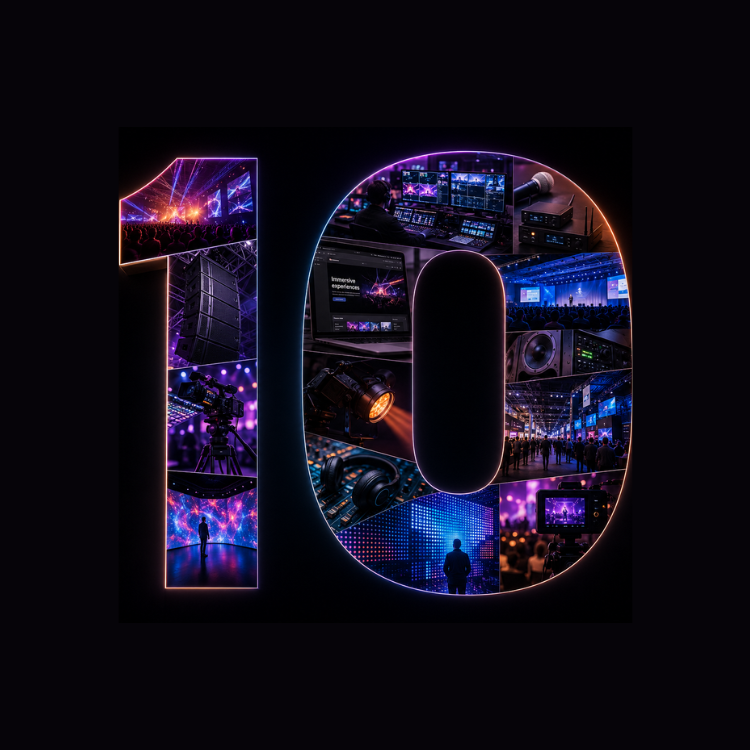
As The Inside Story turns 10 this year, we’ve naturally found ourselves looking back at how much the Pro AV and Professional Audio industries have changed over the past decade. Compared to 2016, it feels like an entirely different landscape now.
Back then, TikTok barely existed outside of China, livestreaming wasn’t normal, immersive audio still felt relatively niche beyond high-end applications and trade shows were often much more straightforward affairs. Booths tended to revolve around product launches, printed brochures and technical demonstrations, whereas now…entire spaces are designed around creating experiences, environments and moments people will actually remember after they’ve left the show floor.
“Ten years ago, you could turn up, put a product on a stand and do pretty well,” reflects The Inside Story Founder, Barney Jameson. “Now people expect more than that. They want something memorable, something they’ll actually connect with.”
When the pandemic hit in 2020 and live events disappeared almost overnight, the industry was forced online instantly. Brands had to quickly figure out how to communicate and engage with their audience digitally, while people were sat at home staring at screens. “Digital stopped being a nice little add-on and became an absolute essential,” says Managing Director Mike Rodel. “Suddenly social media, livestreaming, video content and online engagement weren’t supporting the conversation – they were the conversation.” That period changed expectations permanently. Video content exploded as audiences had become used to faster communication, regular updates and a constant stream of content.
Yet at the same time, the pandemic reminded people how much they valued being physically present. As useful as digital tools had become, they couldn’t replace the spontaneity of a conversation on a trade show floor, a product demonstration or simply chatting and laughing with colleagues and customers face-to-face. The return of trade shows like ISE, InfoComm and PLASA felt different after the pandemic – bigger, louder and strangely emotional. There was a genuine appetite to reconnect properly and you can still feel that now walking around most industry events. The stands that cut through are rarely the ones relying purely on specifications or product displays anymore – they’re the ones creating atmosphere, conversation and interaction.
It’s probably one of the reasons immersive audio and experiential technology have become such huge talking points across the industry too. After years of digital overload, people increasingly want experiences that actually make them feel something. Whether that’s spatial audio, large-scale LED environments, interactive installations or live productions designed around immersion, audiences now expect far more than simply being shown a product. “People don’t really want to be shown technology anymore – they want to step into it,” says Jameson. “That’s why immersive experiences have become so popular. You’re not just watching a demonstration, you’re a part of it.”
At the same time, the barrier to creating content has completely changed. Ten years ago, producing professional video content, building websites or running digital campaigns often felt expensive and heavily guarded. Now, everybody has access to cameras, editing software, AI tools and publishing platforms. Smaller brands can suddenly create genuinely brilliant campaigns without needing enormous budgets behind them, which is hugely exciting creatively – but it also means the amount of content people consume every single day has become overwhelming. Ultimately, attention is harder to earn now.
The challenge isn’t simply making content anymore – it’s making something interesting enough that people will stop scrolling to look at it. TikTok has probably influenced that more than any other platform. Even within B2B industries like Pro AV, you can feel how much quicker, sharper and more visual communication has become over the last few years. Audiences expect immediacy now – they want authenticity and of course, personality. Overly polished corporate messaging often struggles because people are so used to consuming content that feels direct and human elsewhere online.
That shift has massively changed the role of agencies too. PR is no longer simply about securing coverage in publications. Social media isn’t just promotional anymore. Video content isn’t optional. Websites aren’t static digital brochures. Every platform now feeds into a much bigger ecosystem where brands are expected to communicate consistently across multiple touchpoints at once.
Now, of course, there’s AI. It’s near on impossible to talk about the future of marketing, content and creative industries without acknowledging how rapidly AI has entered the conversation over the past couple of years. Whether it’s copywriting, video editing, image generation, translation, research or automation, the tools available to brands now would have felt almost unimaginable 10 years ago.
But it also raises a difficult question: if everybody suddenly has access to the same tools, what makes creative work stand out anymore? “There’s no question AI is going to change the way agencies and brands work,” Rodel adds. “But just because something can be generated quickly doesn’t mean anyone’s actually going to resonate with it – if anything, it makes originality and human understanding even more important and easier to spot.”
Perhaps the most interesting thing about AI is that it no longer feels like a future technology – it’s already woven into how many of us work every day. At the same time, public discourse around it often swings between viewing it as either magic or complete slop, when the reality is far more complicated. AI isn’t a search engine, an employee, an artist or a replacement for human creativity, but it borrows elements from all of those things.
Interestingly, AI may also be giving traditional PR a new lease of life. For years, coverage in respected industry publications has helped brands build credibility with human audiences. Increasingly, it’s helping to build credibility with machines too. As AI tools search for reliable sources of information, authoritative articles, case studies and expert commentary are becoming part of the wider knowledge base they learn from and reference.
In a strange way, the rise of AI could make trusted journalism and industry expertise more valuable rather than less.
The technology is becoming remarkably good at generating plausible, human-shaped output, which means the real value increasingly lies in judgement. Knowing when something sounds right isn’t the same as knowing whether it is right. In many ways, the people who will benefit most from AI aren’t necessarily those who use it the most, but those who understand both its strengths and its limitations. Technology has made creating content easier than ever but making people genuinely feel something from it is probably harder than it’s ever been.
We simply can’t ignore how the wider political and economic climate has shaped the industry over the past decade. Budgets across the events and technology sectors have faced increasing pressure, particularly since the pandemic, while the cost of exhibiting at trade shows has continued to rise. From logistics and freight to hotels, staffing and stand builds, brands have had to work harder than ever to justify where they invest their marketing spend.
But in many ways, that pressure has been a catalyst for better creativity. For years, industry marketing could sometimes feel repetitive: similar adverts, similar messaging and similar campaign structures. Now there’s far more experimentation happening – more personality, humour and risk-taking. Brands are realising that visibility alone isn’t enough anymore – you need to give people a reason to remember you.
Despite how digital everything has become, one thing hasn’t really changed at all over the last 10 years: this industry still runs on the power of relationships. For all the conversations around algorithms, AI and changing platforms, the Pro AV worlds are still built around: people, long days onsite, trade show meetings, shared flights and late-night conversations…inevitably accompanied by alcohol. Trust still matters massively here and audiences can usually tell very quickly when something feels forced or disconnected from the reality of the industry itself. “At the end of the day, this is still a people business,” says Jameson. “The technology changes every five minutes, but relationships are what everything else is built on.”

“People don’t really want to be shown technology anymore – they want to step into it.”